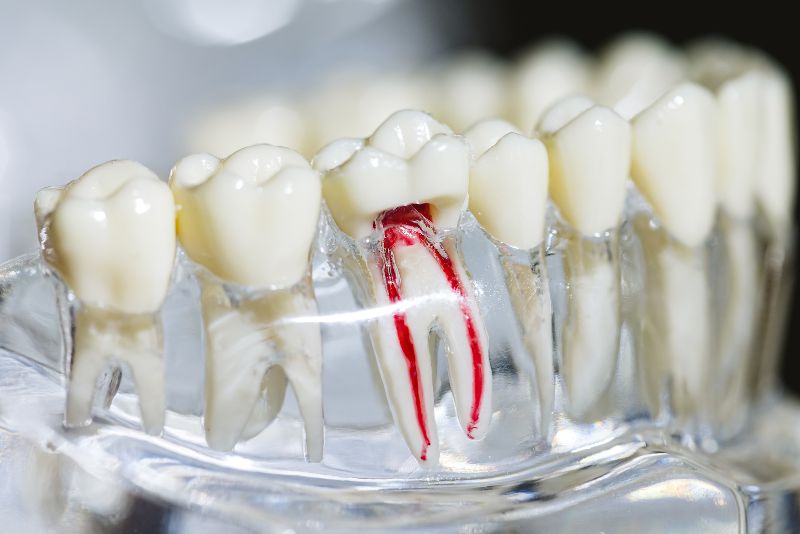
Steps in a Root Canal Procedure
- Diagnosis: X-rays are taken to locate the infected area.
- Anesthesia: Local anesthesia is applied to numb the area, ensuring the patient is comfortable.
- Pulp Removal: The dentist drills a small hole in the tooth and removes the infected or damaged pulp.
- Cleaning and Disinfection: The canals inside the tooth are cleaned, shaped, and disinfected to remove bacteria and prevent reinfection.
- Filling the Canal: The empty root canals are filled with a biocompatible material (usually gutta-percha) to seal the space.
- Sealing the Tooth: The tooth is sealed with a filling or crown to restore its strength and function.
Why Root Canals Are Good
- Saves the Tooth: A root canal allows you to keep your natural tooth, avoiding the need for extraction. Preserving the natural tooth helps maintain proper chewing function and jawbone integrity.
- Stops Pain: Infected or damaged pulp can cause severe tooth pain. A root canal removes the source of the infection, providing relief from pain and sensitivity.
- Prevents Spread of Infection: If left untreated, an infected tooth can cause the infection to spread to the surrounding tissues, bone, or other teeth. A root canal helps stop the spread of infection.
- Restores Function: After a root canal and placement of a crown, the tooth can function like a healthy tooth for biting and chewing.
- Long-Term Benefits: Root canal-treated teeth can last a lifetime if properly cared for, including good oral hygiene and regular dental visits.
In summary, root canals are good because they save damaged teeth, eliminate pain, and prevent further complications like infections, while allowing the tooth to function normally.
Here’s a Frequently Asked Questions (FAQ) guide about root canals to address common concerns:
FAQ
A root canal is a dental procedure used to remove infected or damaged pulp from inside a tooth. The inside of the tooth is then cleaned, disinfected, filled, and sealed to prevent further infection or damage.
You may need a root canal if you have:
- A deep cavity that has reached the pulp of the tooth.
- A cracked or broken tooth that has exposed the pulp.
- An infection or abscess in the tooth that is causing pain or swelling.
- Trauma to the tooth that has damaged the pulp.
The procedure itself is usually painless because it is done under local anesthesia, which numbs the area. Modern techniques and anesthesia make it similar to getting a filling. However, there might be some mild discomfort or soreness after the procedure, which can typically be managed with over-the-counter pain medication.
A root canal usually takes about 60 to 90 minutes, depending on the complexity of the case. Some treatments can be completed in a single visit, while others may require 2 or more appointments, especially for teeth with multiple roots or severe infections.
Signs that you may need a root canal include:
- Persistent tooth pain, especially when chewing or biting.
- Sensitivity to hot or cold that lingers after the stimulus is removed.
- Swelling or tenderness around the gums near the affected tooth.
- Darkening or discoloration of the tooth.
- Presence of an abscess (a pocket of pus).
Your dentist will perform an examination, take X-rays, and make a diagnosis.
After the procedure:
- Mild discomfort or tenderness is normal for a few days, and over-the-counter pain relievers can help.
- Avoid chewing with the treated tooth until it has been restored with a crown or filling.
- Follow-up care is essential, including getting a permanent restoration (crown) if necessary.
- Practice good oral hygiene: brushing and flossing daily.
- Attend regular dental checkups and cleanings.
- Avoid chewing on hard objects (like ice) that could damage the treated tooth.
- Get a crown if recommended to protect and strengthen the tooth.
Most likely, the treated tooth will need a crown or other restoration to protect it from fracture and restore its full function. A crown helps strengthen the tooth, as root canal-treated teeth can become more brittle over time.
While root canal treatment has a high success rate, it can occasionally fail if:
- The infection wasn’t fully cleared.
- The tooth becomes re-infected due to improper sealing.
- A crack or damage occurs after the procedure. In such cases, retreatment or endodontic surgery (apicoectomy) may be necessary.
With proper care, a root canal-treated tooth can last a lifetime. Maintaining good oral hygiene and regular dental visits are key to longevity.
The main alternative to a root canal is tooth extraction. However, after extraction, the missing tooth would need to be replaced with a bridge, implant, or denture to prevent neighboring teeth from shifting and to maintain proper function.
In most cases, a crown is recommended for molars and premolars, as these teeth are more prone to fracture due to the forces of chewing. Front teeth (incisors and canines) may not always need crowns but may still require restoration depending on their condition.
The cost of a root canal can vary based on the complexity of the tooth and location. Molars are generally more expensive to treat than front teeth. Costs can also depend on whether additional procedures like crowns are required. Dental insurance often covers part of the cost, but coverage varies by plan.
Yes, root canals can be safely performed during pregnancy, particularly in the second trimester. Dentists typically avoid elective dental procedures during the first trimester due to the critical development phase of the fetus, but if there is a risk of infection or severe pain, the procedure may still be necessary.
NEW PATIENTS ONLY SPECIAL!
Book by 4/30/2024. Restrictions may apply. Contact us for details.
Cleaning + PerioProtect Combo
Schedule by 4/30/2024. Restriction may apply. Contact us for details.
SMILE WITH CONFIDENCE!
BRACES or INVISALIGN. 0% Financing Available. Restrictions may apply. Contact us for details.
FREE EXAM & X-RAYS
Membership in Dental Alliance (DA) required. DA offers a discount program for dental care.
Deep Cleaning + PerioProtect Combo
Schedule by 4/30/2024. Restriction may apply. Contact us for details.